This doesn’t have to be a difficult choice, but it’s one you need to make carefully.
If you make the wrong choice, then every time you step out, that surface will always remind you of how unhappy you are with it until someday when maybe another surface replaces it again.
However, get it right, and you have an outdoor space that actually gets used.
The fact is, both paving and decking have their moments to shine.
Neither one is better than the other. What works brilliantly for your neighbour’s place might be completely wrong for yours, and that’s before we even get into Sydney’s weather or your budget or maintenance requirements.
Let’s get down to it. No fluff, no corporate speak – just a straight-up comparison that will actually help you make a decision you won’t regret about outdoor flooring options.
Why This Decision Matters More Than You Think
Here’s something most people never realise until it’s too late: your patio surface affects everything else about your outdoor space.
The material you choose determines which furniture works best, how hot the area gets during summer, how slippery it becomes after rain and whether children can play on it barefoot without burning their feet.
It is also a significant investment. Whichever way you choose to go, paving or decking, you’re looking at a material that should last decades if you treat it right. That’s quite some time to be living with a decision made in haste.
The Case for Paving
Let’s start with paving, which has been the go-to choice for Sydney patios for years. There’s a reason for that popularity that goes beyond just tradition.
Built to Last
Durability is paving’s biggest selling point. We’re talking about a surface that can handle pretty much anything Sydney’s climate throws at it. Summer heatwaves? No worries.
Those random hailstorms? Paving laughs at them. Even furniture being dragged across won’t do much damage to good-quality pavers.
Style and Variety
Sandstone pavers keep that classic Sydney look. Concrete pavers are available in more colours and patterns than you ever thought possible. Travertine looks amazing, but it is more expensive. Porcelain pavers can imitate timber – without the maintenance problems.
Easy to Maintain
The main work involved in maintaining paved areas is regular sweeping. An occasional pressure wash of the surface will make it look as good as new.
Stains can easily be removed by hosing them off with water; there will never be a need to reseal or re-oil every year, unlike decking products. The colour does not fade – that’s what you get today and that’s what you’ll have ten years down the line.
The Drawbacks
But paving is not perfect. It gets seriously hot underfoot during Sydney summers, particularly for darker colours. The heat retention can make the area less comfortable on those 35-degree days when you’re trying to enjoy dinner outside.
Upfront installation costs can make it pricier than simple basic decking. There needs to be proper base preparation – excavation, compacting, and sand bedding.
At Divine Landscapes we undertake all of this work, and it is essential to follow the proper procedures, as taking shortcuts would lead to problems later.
Some also find paving a bit cold aesthetically. It’s hard and modern. Perfect if that’s your style, but if you are after something warm and organic, timber might be more your thing.
Once the surface of your patio has been completed, another thing to consider would be lighting options that could brighten up your outdoor living space, making it more functional for evening entertainment.
The Case for Decking
Decking brings something to the table that paving simply can’t match – warmth. And I’m not talking about temperature here, but rather that visual and tactile warmth that timber provides.
There’s just something about a timber deck that makes an outdoor space feel more inviting, more like an extension of your living room rather than just a concrete slab out back.
Design Flexibility
Decking offers impressive aesthetic flexibility. You can have it at different heights; you can multi-level it; you can wrap it around trees and provide built-in seating.
Try doing that with pavers without a significant increase in complexity and cost. Decking works with the contours of your land rather than requiring everything to be perfectly flat, which is a massive advantage on sloping Sydney properties.
Stays Cooler in Summer
This is really where decking comes into its own. While paving absorbs and radiates heat that can burn your feet, timber decking stays comfortably cool enough for bare feet.
That makes it a better option for families with young kids playing outside or anyone interested in using their patio during Sydney’s hotter months without footwear.
The Maintenance Reality
Here’s the tricky part about decking, though. Maintenance is real and you can’t just ignore it. Most timber decking needs to be cleaned and then oiled or sealed annually to keep it looking good and prevent weathering.
Skip a few years and you’ll start seeing that silvery grey colour. For more tips on protecting your outdoor surfaces from Sydney’s conditions, check out how to weatherproof your yard.
Other Considerations
Composite decking is worth mentioning here. It’s more expensive than timber but doesn’t need annual oiling, which sounds great. The catch?
You lose that real timber feel, and while composites don’t get quite as hot as timber in direct sun, they still get warm enough that you might not want to walk barefoot during a summer arvo barbecue.
The cheaper composite options are available too, but they look pretty obviously fake – you’re not fooling anyone.
The Slip Factor
Timber decking gets slippery when wet, and that matters because Sydney can throw a sudden shower at you any time. If you’re building next to a pool or in a generally damp area, think carefully about the timber species and finish that will best minimise slip risk.
Termites
Termites are a real concern in Sydney, which means you’ll need to use termite-resistant timber species like spotted gum or ironbark, or go with treated pine. Either way, it’s an extra consideration that simply doesn’t apply to paving.
Sydney-Specific Factors That Matter
Living in Sydney means dealing with a specific climate that affects your choice between paving and decking more than you might realise. What works in other cities might be completely wrong for your backyard.
Hot summers favour decking’s cooler feel, but Sydney’s intense UV accelerates fading on any outdoor material.
Rainfall affects materials differently too – paving dries faster, while timber decking absorbs moisture, which can lead to swelling and rot if drainage isn’t right.
Raised decking often needs council approval, particularly if it’s above a certain height or close to boundaries.
According to the NSW Planning Portal, decks must meet specific requirements to be exempt from planning consent. Ground-level paving usually doesn’t trigger these requirements.
If you’re in a bushfire-prone area, you may need BAL-rated materials. The NSW Rural Fire Service provides guidelines on Bushfire Attack Level requirements, which can affect your material choices.
Divine Landscapes handles all these local considerations as part of our landscape construction services. We’ve worked across Sydney and know what actually works for your specific location.
The Money Question
Let’s talk costs because this is probably sitting in the back of your mind through this whole article.
Basic concrete paving typically clocks in at a total slightly lower than mid-range timber decking for materials alone.
However, paving installation (excavation, base work, compacting) can push the total cost up, particularly if your site has drainage issues or unstable soil. Most contractors will never tell you about added costs until they find “unexpected” soft spots during construction.
| Cost Factor | Paving | Decking |
| Installation Complexity | High (excavation, base prep) | Medium (frame, fixing) |
| Annual Maintenance | Low ($50-$150/year) | Medium-High ($200-$500/year) |
| Lifespan | 25-50+ years | 15-30 years (timber) |
| Replacement Cost | Very high | Medium-High |
| 20-Year Total Cost | Higher upfront, lower ongoing | Lower upfront, higher ongoing |
Here’s something most people forget about – lifecycle costs. Yes, paving has higher upfront costs but there are hardly any ongoing expenses to be paid for.
Decking can be cheaper to install but it will require annual maintenance each year over a period of twenty years; all these costs eventually sum up to one big cost! If you’re flipping houses, then the initial investment is what matters the most. If this is your forever home, then total lifecycle cost becomes more relevant.
Making the Right Choice for Your Space
Divine Landscapes has helped clients resolve this common dilemma, having constructed hundreds of outdoor spaces. Here’s what we usually suggest to them:
Choose paving if:
- You want minimal ongoing maintenance.
- Your patio gets full sun most of the day and you won’t be using it barefoot.
- You prefer a modern, clean aesthetic.
- You’re building near a pool where slip resistance and water tolerance are priorities.
- You need a perfectly level surface for specific furniture or features.
Go with decking if:
- You love the warmth and natural look that only timber provides.
- Your family will use the patio barefoot during summer.
- You have a sloping site where building at different levels makes sense.
- You’re willing to commit to annual maintenance.
- You want something that feels like an outdoor room rather than a paved area.
Consider a combination if:
- You have a large backyard area that can be separated into different defined areas.
- You want to use both materials for multipurpose benefits.
- Your budget allows it, and you like the visual interest of mixed materials.
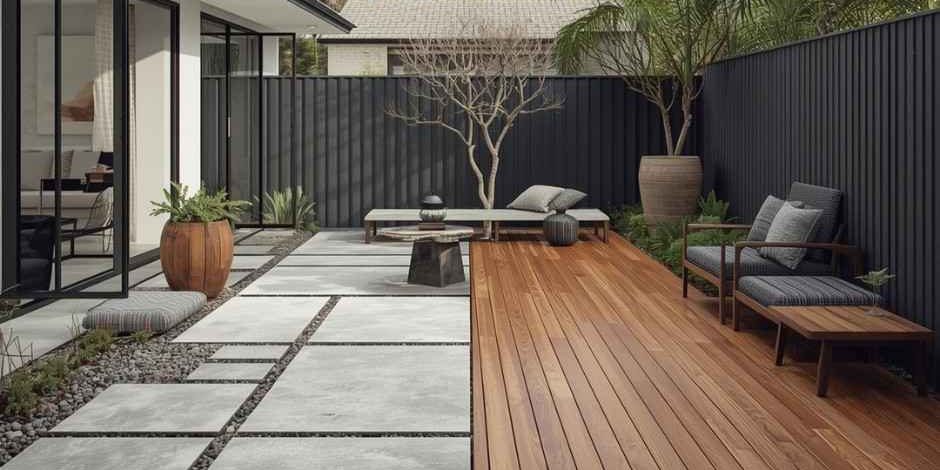
This is not an unusual approach. We have completed numerous projects in which decking provides a raised entertaining area near the house while paving takes care of paths and areas around fire pits or outdoor kitchens where heat and sparks are concerns.
Getting the Installation Right
Here’s something that matters more than your material choice – getting it installed properly. A badly laid patio is a nightmare regardless of whether you picked paving or decking.
For paving, this means proper drainage so water doesn’t pool or drain towards your house, adequate base preparation so pavers don’t sink, and attention to details like expansion joints and edging.
For decking, proper installation means using the right fixings and spacing, creating adequate ventilation underneath, and building to a structural standard that won’t bounce when people walk on it.
NSW Fair Trading states that all building work must meet minimum technical standards and quality requirements. Building work includes outdoor structures such as decks or patios.
This is exactly what Divine Landscapes specialises in. Our construction team handles the entire process from design through to completion, making sure all the technical stuff is sorted properly.
We work across all of Sydney, from the Northern Beaches to the Hills District.
The Real Answer? It Depends
I know that’s probably not the definitive answer you wanted. But both paving and decking can create fantastic patios when they’re right for the situation.
The real question isn’t “which is better?” but rather “which is better for my property, my budget, and how I actually want to use this space?” Answer those questions honestly and the choice becomes clearer.
Of course, that’s what Divine Landscapes is here for.
We can come out and take a look at your area and give you real advice on which outdoor flooring options make the most sense. Sometimes it’s paving. Sometimes it’s decking. Sometimes it’s both.
Do not rush to make a final choice without getting some professional opinions first.
Your future self will be grateful to you when, on some perfect evening in Sydney, you’re sitting out there quite content with what lies beneath your feet.